Research
Research interests
Structure-preserving methods for incompressible flows

I am interested in discretizations that respect the structure of the underlying physics at the discrete level. For the incompressible Navier-Stokes equations, a central tool is H(div)-conformity. Enforcing mass conservation pointwise gives energy stability and pressure robustness at the same time, and makes methods robust for convection-dominated flows.
A key idea in my work is to relax conformity in the right places. In the mass conserving mixed stress (MCS) method, the velocity lies in H(div) and the viscous stress in a matrix-valued space with normal-tangential continuity, based on the H(curl div) function space. This combines exact mass conservation, pressure robustness and energy stability, without stabilization parameters to tune.
Pressure robustness also matters for classical mixed methods, which do not have it by construction. Divergence-conforming reconstruction operators remove the spurious coupling between velocity errors and pressure, and the same ideas lead to pressure-robust a posteriori error estimators.

Other structures are worth preserving too. The physical stress tensor, for example, is symmetric, and keeping this property exactly at the discrete level demands dedicated techniques, such as suitable subdivisions of the mesh elements.
Divergence-free reconstruction · Relaxed H(div)-conformity · MCS method · Commuting interpolation
Turbulence and high-order simulation

How far can structure-preserving discretizations go for flows at high Reynolds numbers? Since the MCS method introduces only minimal numerical diffusion, it is an attractive basis for turbulence modelling, because any added dissipation can be controlled precisely.
One idea I find particularly useful is to apply upwind stabilization only to the high-order part of the velocity jump across element facets. This allows implicit large eddy simulation without an explicit sub-grid model, and gives accurate energy cascades for turbulent channel and airfoil flows, including transition to turbulence over the Eppler 387 airfoil.
Kelvin-Helmholtz instability · Implicit LES · Transitional flows
Compressible flows, positivity and entropy stability
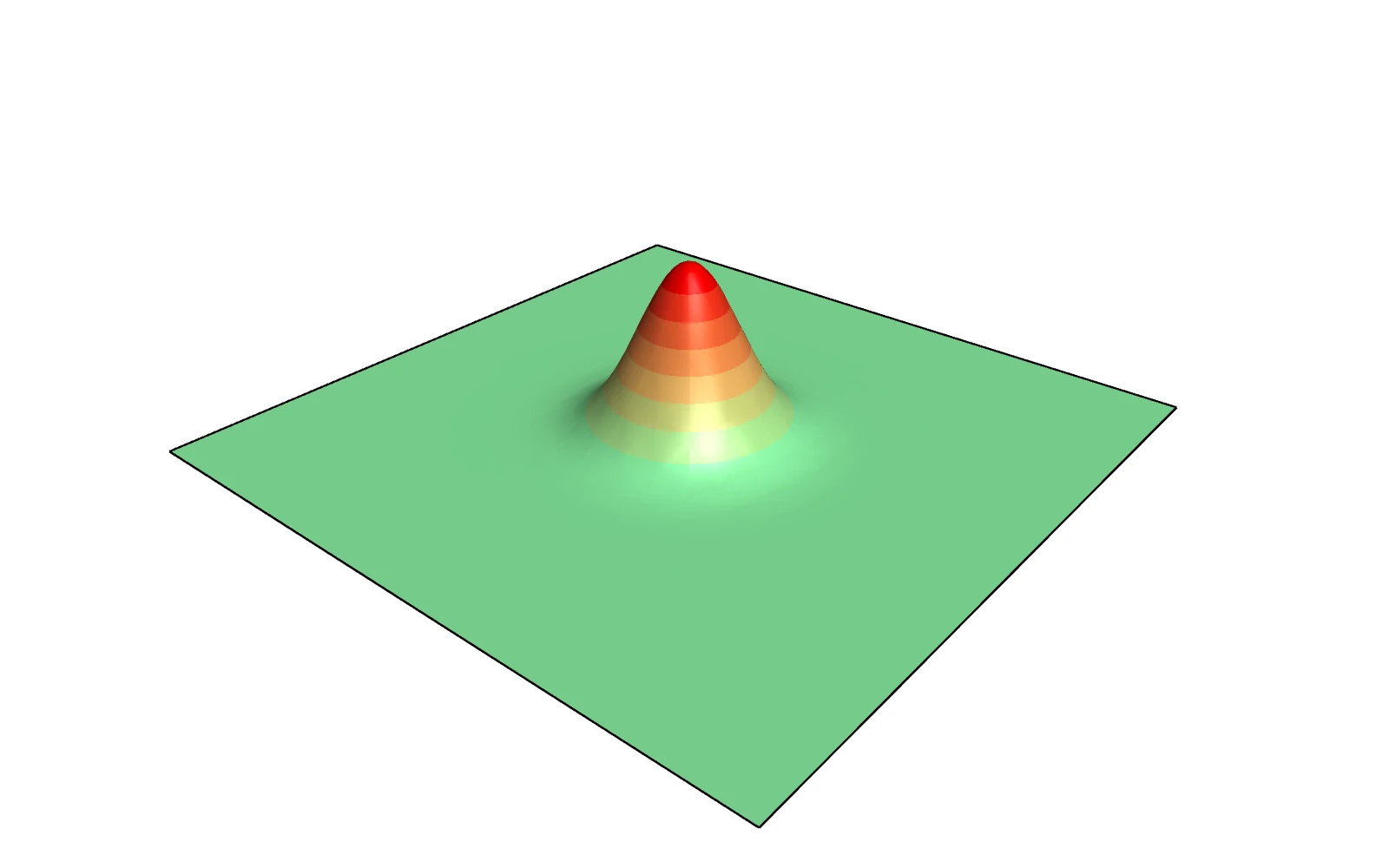
I work on hybridizable discontinuous Galerkin (HDG) methods for computational aeroacoustics, the direct simulation of how sound is generated and propagates in unsteady and turbulent flows. Because acoustic waves are so much weaker than the flow, this requires low-dissipation methods, non-reflecting boundary conditions at artificial boundaries, and efficient time integration. IMEX schemes, for example, can treat stiff regions implicitly with HDG and the rest of the domain explicitly with DG.
Pressure robustness has a compressible counterpart in gradient-robust, well-balanced schemes. These exactly balance gradient forces even for non-constant densities, so hydrostatic equilibria are captured up to machine precision.
High-order schemes need additional structure to stay physical near shocks and steep gradients. I am therefore interested in positivity and bound preservation, in when discrete solutions remain in their admissible range, and in entropy stability for hyperbolic systems such as the compressible Euler and Navier-Stokes equations.
See also the DreAm project.
Characteristic boundary conditions · IMEX schemes · Gradient-robust compressible Stokes · Positivity of HDG on hypergraphs · Bound-preserving enriched Galerkin
Other topics
Trefftz methods build local solutions of the PDE into the discrete spaces, which can greatly reduce the number of degrees of freedom. I am interested in how these ideas fit into a common framework, and in how far they carry beyond linear model problems.
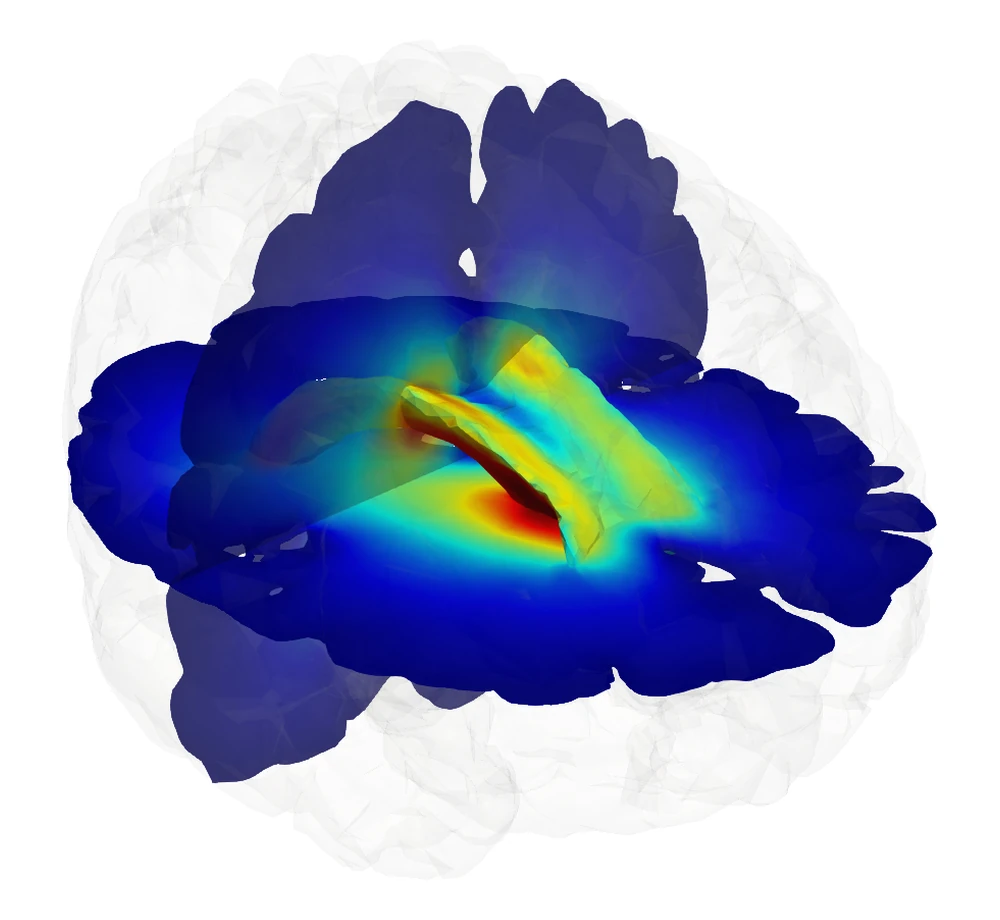
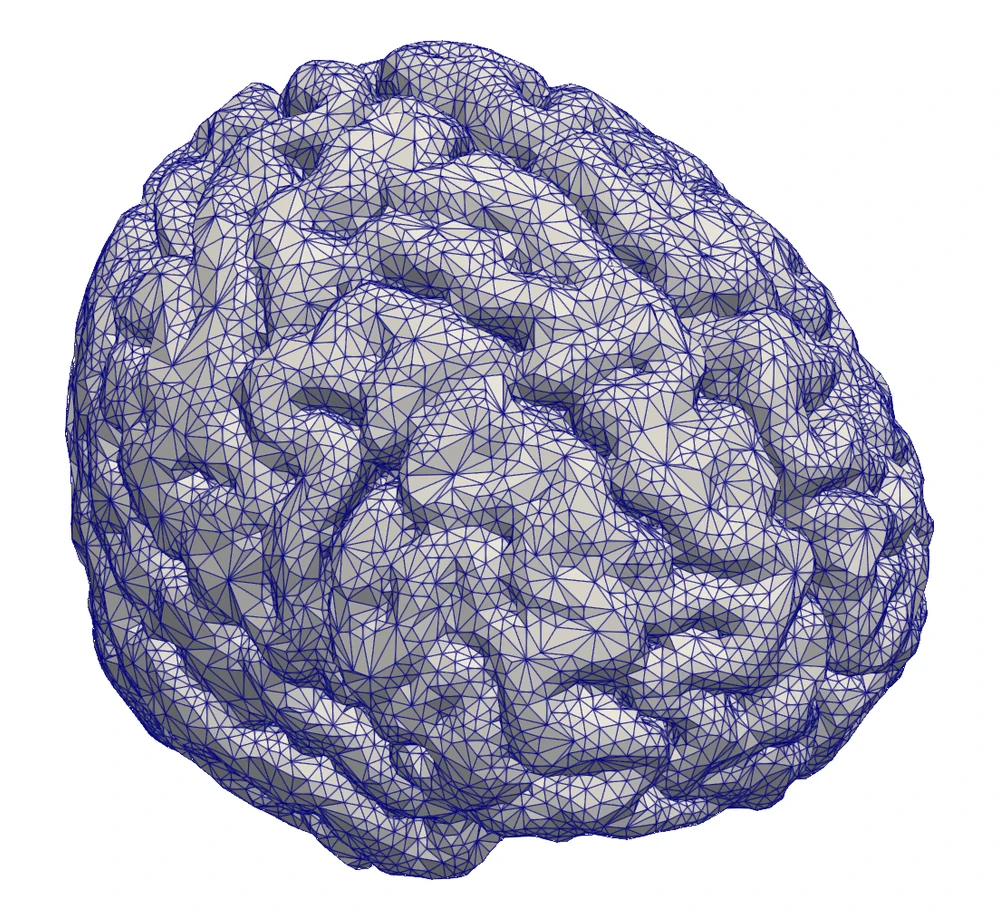
Coupled problems like the Biot consolidation model call for mass-conserving discretizations and preconditioners that remain robust across all model parameters. Multiple-network poroelasticity extends this to applications such as simulations of the human brain. More generally, I work on auxiliary space preconditioners that make methods like MCS usable for large problems.
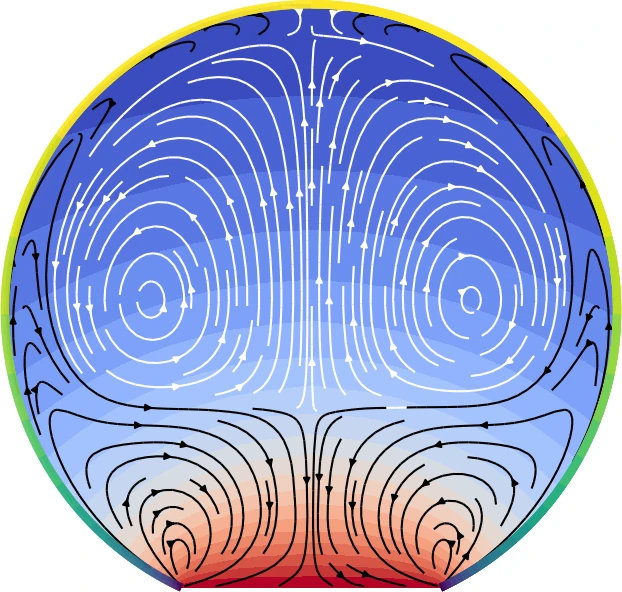
I also enjoy applications where flow and transport interact, such as evaporating droplets. Small physical effects can change the whole flow there, and a discretization has to respect physical properties like the positivity of concentrations.
Further interests include high-order DG methods for moist atmospheric flows, mixed methods for elasticity, variational inequalities such as Bingham flow, a posteriori error estimation, eigenvalue problems and photonic crystals.
Trefftz DG for Stokes · Unified Trefftz framework · Embedded Trefftz for Navier-Stokes · Biot's consolidation model · Multiple-network poroelasticity · Auxiliary space preconditioner · Evaporating droplets · Atmospheric flows · Symmetric mixed elasticity · Bingham flow · A posteriori estimation · Eigenvalue estimates · Photonic crystals
Try it: why pressure-robustness matters
Consider the Stokes problem on the unit square where the force f is chosen so that the exact velocity u and pressure p are known:

The views below show the discrete solutions of this problem for the Taylor-Hood method and for the H(div)-conforming MCS method. For small viscosity, the force f is dominated by the pressure gradient. Taylor-Hood is not pressure robust, so its velocity error grows as the viscosity decreases, while the velocity of the MCS method is not affected by the pressure. Switch between the fields and viscosities to compare them. You can rotate and zoom both views.

